Shadow testing runs new service versions alongside the current one with identical traffic, offering a low-maintenance alternative to brittle integration tests for validating real-world behavior without user impact. Ideal for microservices, it catches issues early, complements traditional testing, and differs from canary releases and feature flags by shifting validation left, with tools like Diffy and Signadot enabling scalable, sandboxed testing in Kubernetes for faster, safer deployments.
Originally posted on The New Stack.
Shadow testing runs new service versions alongside the current one, processing the same traffic for direct comparison.
“Oh, yes,” a head of platform said sheepishly, “we used to have integration tests, but eventually no one wanted to maintain them, and they mostly started to fail. So we had to turn them off.”
What started with the best intentions — to catch breaking changes early — became a maintenance burden as services evolved. Schemas kept changing, tests kept breaking and fixing them felt like a losing battle. This is a familiar story for teams running microservices: Integration tests, built with high hopes, often become unreliable, leading teams to either overcommit to maintenance or abandon them altogether.
Shadow testing offers a fundamentally different approach to ensuring safe deployments. Instead of relying solely on mocks, stubs or brittle integration tests, shadow testing runs new service versions alongside the current one, processing the same traffic for direct comparison. This allows organizations to validate real-world behavior without affecting users. Unlike traditional preproduction tests, shadow testing:

However, we should mention that the traffic doesn’t necessarily have to mean production traffic — it can include synthetically crafted requests that closely mimic production traffic. The closer this representative traffic is to real-world conditions, the more valuable the test results, of course.
As noted in Microsoft’s Engineering Fundamentals Playbook, “Shadow testing reduces risks when you consider replacing the current environment (V-Current) with candidate environment with new feature (V-Next). This approach is monitoring and capturing differences between two environments then compares and reduces all risks before you introduce a new feature/release.” This ability to safely test under realistic conditions makes shadow testing an invaluable strategy for modern software teams.
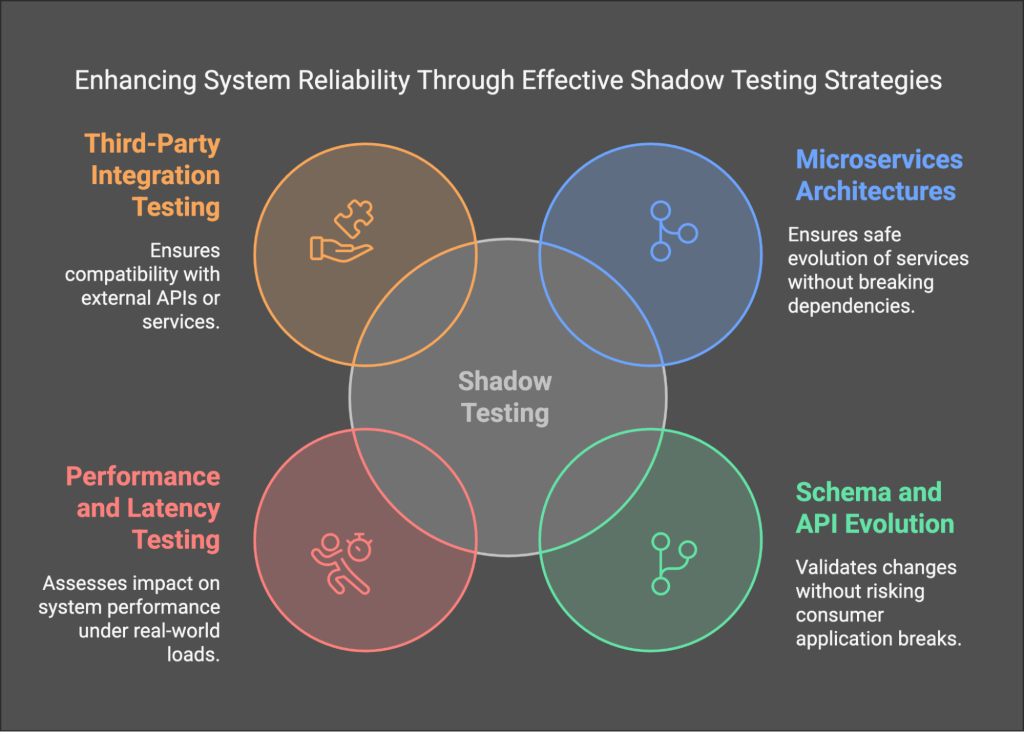
Shadow testing is especially useful for microservices with frequent deployments, helping services evolve without breaking dependencies. It validates schema and API changes early, reducing risk before consumer impact. It also assesses performance under real conditions and ensures proper compatibility with third-party services.
Let us now compare it to other forms of testing that are familiar to most engineering teams:

Now, you might ask: “Isn’t this just like canarying or feature flagging?” Not quite. While all three manage risk in deployments, they serve different roles:
Shadow testing doesn’t replace traditional testing but rather complements it by reducing reliance on fragile integration tests. While unit tests remain essential for validating logic and end-to-end tests catch high-level failures, shadow testing fills the gap of real-world validation without disrupting users.
Shadow testing follows a common pattern regardless of environment and has been implemented by tools like Diffy from Twitter/X, which introduced automated-response comparisons to detect discrepancies effectively.

Some of the key aspects of such tools are:
The environment where shadow testing is performed may vary, providing different benefits. More realistic environments are obviously better:
This structured approach ensures that a service change is validated under real conditions while minimizing deployment risks.
Shadow testing isn’t just another testing strategy. It’s a shift in the way modern organizations approach software validation. With traffic in safe, sandboxed environments, teams can eliminate the trade-off between speed and reliability. For organizations tired of the brittle nature of traditional integration tests, shadow testing offers a practical, scalable alternative that reduces risk while accelerating development.
If you are running microservices in Kubernetes, Signadot enables teams to run shadow tests easily, whether using Linkerd, Istio or even without a service mesh. With lightweight environments that integrate seamlessly into CI/CD pipelines, organizations can:

Implementing shadow testing at scale requires infrastructure capable of isolating test environments, handling traffic isolation and providing observability. How do you use shadow testing in your organization? We’d love to hear about your experiences and best practices.
Get the latest updates from Signadot