
Cloud native verification platform
AI writes code.
We make sure it works.
Catch what AI-generated code breaks before merge. Each change gets an ephemeral environment without duplicating the stack, so agents and CI test hundreds of changes in parallel.
- No credit card required
- Playground cluster available
Trusted by engineering teams worldwide




















What makes Signadot different
Realistic environments, as many as your team and agents need
Every change needs a realistic environment to be tested in, and coding agents make many changes at once. Signadot environments are realistic and light enough for each change to get its own.
The usual way
A full copy of the stack per environment
Most ephemeral environment tools copy the entire stack for each environment they create. Full copies are slow to start and costly to run, so teams can afford only a few, while coding agents need one for every change.
Signadot
Light enough for every change
A Signadot ephemeral environment starts in seconds and costs a fraction of a full copy, yet behaves like an entire environment, with real services, data and queues. Hundreds share one cluster. See how it works
Your tests run in the same environments
Jobs
Run your test suites
Run the Playwright, Cypress or custom suites you already have inside your cluster, in parallel, each against its own ephemeral environment.
Learn more about jobsPlans
Checks coding agents run
Compose actions into reusable plans that coding agents run to check their changes in an ephemeral environment.
Learn more about plansResults customers report
Miro replaced about 15 fixed test environments with 3 shared ones, and its teams and agents test in parallel.
Read the Miro storyBitso gives 250+ engineers and their coding agents an environment for every pull request, across 200+ microservices.
Read the Bitso storyEarnest runs its end-to-end suites in parallel, so developers find issues before their code reaches staging.
Read the Earnest storyHow it works
Ephemeral environments for the whole cloud-native system
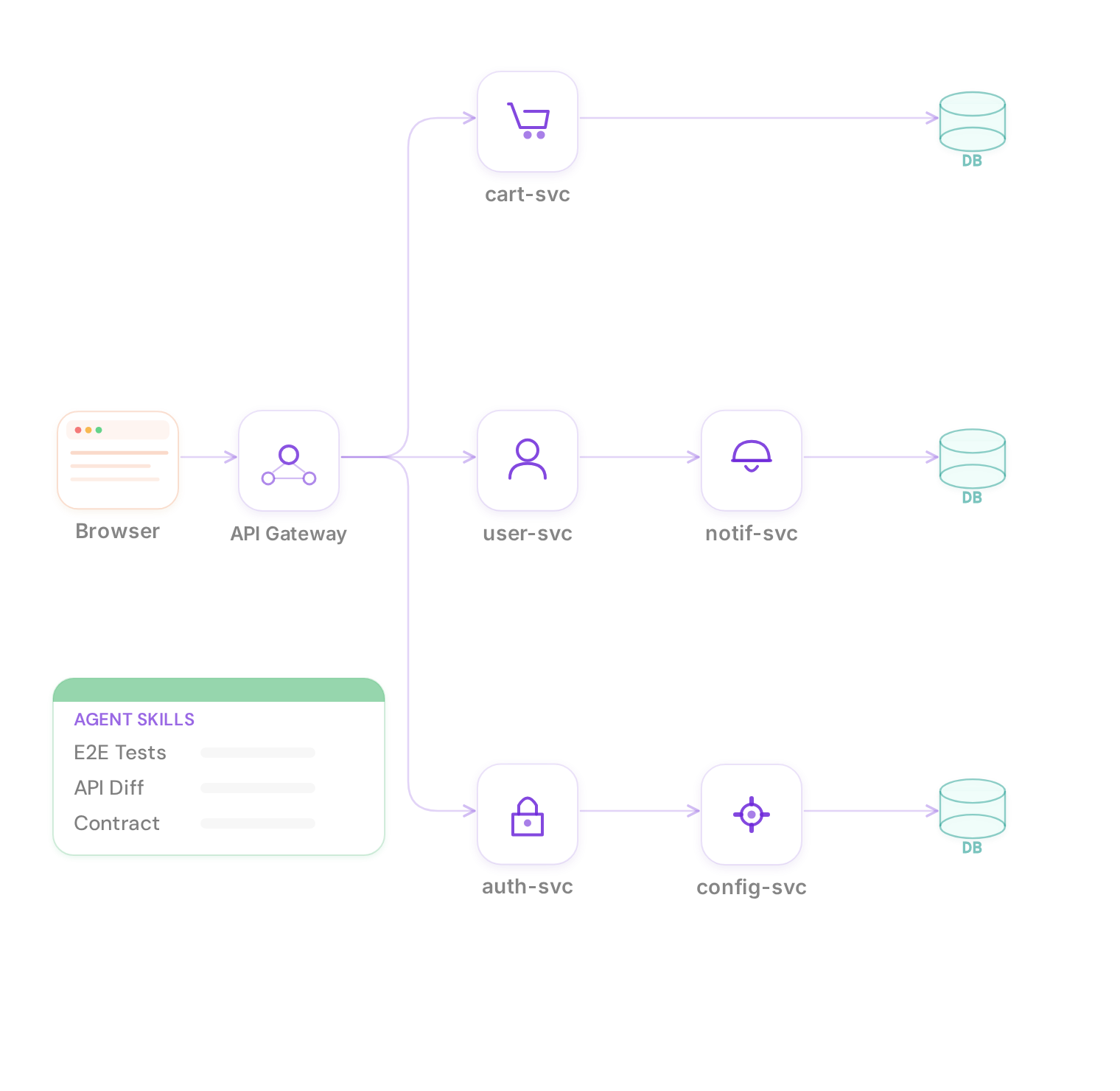
An ephemeral environment copies only what changed and wires it into an environment you already run, such as staging. Signadot does the wiring for requests, messages and resources.
Routing requests
Each ephemeral environment has a routing key. A request that carries it reaches the environment's copy of a service at every hop, and the shared version of everything else. Signadot sets up the routes in your service mesh, such as Istio, or with its own sidecar.
Routing messages and tasks
Messages, workflow tasks and jobs carry the routing key too. Consumers and workers in an ephemeral environment take only the work tagged for it, and the baseline takes the rest, so every environment shares the same brokers and queues.
Resource plugins for the rest
Some components need a copy of their own, such as a database for a schema change, or live outside Kubernetes, such as a managed queue. Your platform team describes how to create them once, as a resource plugin. Any environment can then have its own, created when it starts and removed when it ends.
Across your stack
-
Databases Share the database with each environment's data kept apart, or give an environment a temporary database or a branch from Neon or Xata.
Data isolation -
Message queues One shared broker for every environment, with guides for Kafka, RabbitMQ, NATS, SQS and SNS, and Google Pub/Sub.
Message queue isolation -
Workflows and batch jobs The routing key travels with every workflow, task and job, down to the steps they start, so the right workers pick them up.
Temporal workers -
Cloud resources Managed databases, queues, buckets and other cloud services outside Kubernetes, created with Terraform, a cloud CLI or a script.
Resource plugins
Where it fits
Fast feedback from local dev to pull request merge
The same ephemeral environments serve both loops of development: developers and coding agents testing as they write code, and CI testing every pull request before merge.
Developers and coding agents test as they write code.
- Write code A developer or a coding agent makes a change, on a laptop or in a cloud sandbox.
- Run it in an ephemeral environment Through the CLI or the MCP server, the changed code joins an ephemeral environment in your cluster, ready in seconds.
- Test and iterate The agent runs end-to-end and integration tests against real services, reads the failures, fixes them and runs them again.
CI tests every pull request before merge.
- An environment for every pull request CI creates an ephemeral environment for each pull request, the same kind the inner loop uses.
- Run your test suites End-to-end, regression and performance suites run against it, from CI or in the cluster.
- Merge with confidence The change has been tested in both loops before it merges.
Who it's for
Built for how your team actually works
Different roles, same platform. Signadot fits into your existing workflows.
For Engineering Leaders
You're being asked to adopt AI coding tools and increase developer productivity without increasing headcount or cloud spend. Signadot is the infrastructure layer that makes that possible. Scale testing to match the pace of code generation, without scaling costs.

$2M saved annually
Signadot for the preview environments use case fit what we were trying to do better than anything else. It was a more mature solution than the other stuff that we were looking at. And the return on the investment was obvious... just in infrastructure costs, it saves us about $2 million annually.
 Phil BurrowsHead of Platform Engineering
 For Platform Engineers
You need infrastructure that fits your existing stack, not another abstraction to manage. Signadot installs as an operator in your Kubernetes cluster and works with your service mesh (Istio, Linkerd), CI/CD pipelines and OpenTelemetry. Give your developers and their agents self-service environments without filing tickets.

82% lower change failure rate
Signadot is making it easier for our developers to build and test microservices using deployments that are incredibly similar to production. This has made both human and AI-written code easier to validate and test.
 Naomi KleinLead Infrastructure Engineer
 For Developers
Get instant feedback on every change, against real services. Your coding agents can spin up ephemeral environments, run tests, and iterate autonomously to give you back the time you'd spend babysitting their output.

No more fighting over staging
Creating a sandbox is extremely fast, it works every time, lets me test what I'm building quickly, and move on. This is awesome.
 Tyler MarienSenior Software Developer
 The platform
Everything your team needs to ship with confidence
A closer look at the tools behind both loops: local development against real services, an ephemeral environment for every pull request, test suites in your cluster and plans that coding agents run. Together they let your team test AI-generated code during development and before merge, so you ship as fast as code is written.
Local development with real services
Developers and coding agents use the CLI or the MCP server to connect a local workstation to your Kubernetes cluster over a secure, two-way tunnel. Test local changes end to end from web, mobile or API frontends, with no mocks.
Learn more about local testingEphemeral environments for every pull request
Your CI creates an ephemeral environment for every pull request, hundreds at a time. Preview the change in a browser or on a phone, and run functional and non-functional tests against it before merge.
Learn more about pull request environmentsSandbox pr-276-frontend created
Routing key nm2cqkbfxqzml
Tests Summary
- checkout e2e
- login e2e
- orders api
Run E2E and integration tests pre-merge
Run your Playwright, Cypress or other suites as Jobs, inside your Kubernetes cluster, against any ephemeral environment. End-to-end and integration problems show up before merge, not after.
Explore test scenariosSignadot Plans
Platform teams build secure custom actions inside your Kubernetes cluster. Developers compose them into plans that coding agents run to check their changes. Every run is deterministic and uses no tokens, so plans stay fast and cheap at scale.
Learn more about plan-based validationVoice of our customers
Customer Success Stories


Frequently Asked Questions
How is Signadot different from other solutions?
Most ephemeral environment tools copy the whole stack for every change. Signadot multiplexes many ephemeral virtual environments within one physical environment, such as staging, and each one duplicates only the components a change touched. That keeps them light and fast to create, so hundreds run in parallel for developers and coding agents.
What capabilities does Signadot offer?
Local development. Run the service you are changing on your laptop, or let a coding agent do it, inside an ephemeral environment with real dependencies.
Preview environments. An ephemeral environment for every pull request, including web and mobile frontends.
Your own automated tests. Run Playwright, Cypress, k6 or any other suite in your cluster against each environment.
Smart Tests. API tests that compare a changed service with the baseline and flag breaking changes.
Coding agents. An MCP server and agent skills let agents create environments and test their own changes.
How does Signadot enable agentic development?
Each coding agent gets its own ephemeral environment with real services and data, whether it runs on a developer's laptop or as a background agent in the cloud. The agent runs its code against the real system, reads the errors, fixes them and runs its tests again before anyone reviews the change, without touching anyone else's work.
What coding agents does Signadot integrate with?
Any coding agent that supports the Model Context Protocol (MCP) or agent skills, including Claude Code and Cursor. Agents create and manage ephemeral environments and test their changes from inside their own workflow. Background agents running in cloud sandboxes get their own ephemeral environment too.
What is the Signadot MCP server?
The Signadot MCP server connects coding agents to your Kubernetes clusters through the Model Context Protocol. It ships with the Signadot CLI and gives agents tools to create and manage ephemeral environments and read cluster context, so they can test their changes against real services from a prompt.
What is a Signadot ephemeral environment?
An ephemeral environment, called a Sandbox in the Signadot CLI and API, holds only the components a code change touches and shares everything else in your existing environment, such as staging. Whoever uses it sees what looks like a full copy of staging, without interfering with anyone else's work.
Where do ephemeral environments run?
Inside the Kubernetes clusters you already run. Signadot installs as an operator, so workloads, data and tests stay in your infrastructure. The Signadot control plane manages the environments but sees only resource metadata by default, never your code or application data.
How much effort is it to get started?
Most teams create their first ephemeral environment in about 15 minutes. You install the Signadot operator in your Kubernetes cluster and use the CLI to create an environment and run your tests, or start on our playground cluster with no cluster of your own.
How does Signadot integrate with CI/CD systems?
Through the Signadot CLI, as a step in any pipeline. The pipeline creates an ephemeral environment for each pull request, runs your tests against it, and deletes it when the pull request closes. The docs have guides for GitHub Actions, GitLab CI, Jenkins and Bitbucket Pipelines.
Does Signadot require a service mesh?
No. Without a mesh, or with Linkerd, a lightweight DevMesh sidecar routes each request to the right environment. If you run Istio, Signadot updates the routing rules in your VirtualServices and adds no sidecar of its own, in sidecar or ambient mode. It also works with the Gateway API. The routing key travels in the OpenTelemetry baggage header your tracing libraries already pass along.
Does Signadot support running automated tests?
Yes. Signadot runs your existing test suites, such as Playwright, Cypress, Selenium, Postman, k6 or your own, in your cluster against each ephemeral environment, on pre-warmed runners, with the results in one place. Coding agents can also write new tests and run them in their environment, which gives them immediate feedback on their changes.
What are Signadot Smart Tests?
Smart Tests are API tests you write once in Starlark. Signadot sends the same requests to the changed service and to the baseline, and a model flags the differences that matter, such as a removed field or a new error, without an assertion for every field. They cover REST APIs with JSON and complement contract tests rather than replacing them.
Is Signadot secure?
Yes. Signadot runs in your infrastructure, and its control plane receives only resource metadata by default, never your code or application data. It supports SSO and role-based access control, and Signadot is SOC 2 Type II. See the security docs.
What types of applications work best with Signadot?
Cloud native applications built from microservices on Kubernetes, especially with 10 or more services, where testing a change against real dependencies gets hard. It also suits teams adopting coding agents, where 50 or more agents and developers need environments at once. Resource plugins bring in what runs outside Kubernetes, such as managed databases and cloud services.
How does pricing work?
Signadot has a free Starter plan, and paid plans that scale with usage as your team and coding agents ship more changes. See the pricing page, or talk to us for a custom quote.
How does Signadot compare to testing tools like Playwright, Cypress or Selenium?
Signadot works with them rather than replacing them. Those tools run your tests. Signadot gives each change a realistic ephemeral environment for them to run in, and runs them in parallel across many environments.
Latest on Scaling Agentic Development
-

Running AI Agents on Kubernetes: A Map of the Open Source Projects
Agent Sandbox, Agent Substrate, AX and kagent each fill a different gap Kubernetes leaves for AI agents. What each one solves, how they fit together, and which to build on today.
-

Code Generation Isn't the Bottleneck Anymore: What Platform Leaders Told Us Over Dinner
Platform, security and AI leaders agreed on one thing at our recent executive dinner: agents made code cheap, and everything after the code is now the constraint.
-

Verification Is the New Bottleneck: Takeaways From DZone's Cloud-Native Foundations Trend Talk
Drift, late staging failures and agent pull request volume are moving cloud-native delivery's bottleneck to verification. Key themes from DZone's Cloud-Native Foundations Trend Talk.