The AI boom has made code generation instant, moving the development bottleneck to validation. This article argues that Kubernetes is your secret weapon, not your problem. By utilizing its power to create ephemeral, isolated "sandbox" environments for every AI-generated feature, teams can quickly run full end-to-end tests against a production-like stack. This accelerates experimentation and validation, transforming your development pipeline into a high-speed "experimentation engine" and ensuring you keep pace with rapid innovation.
Image by Guille Alvarez on Unsplash.
Let’s get one thing straight: In the AI era, the only thing that matters is experimenting faster than your competition. Generative coding assistants are enabling rapid iteration and users are flocking to whichever platform offers them the latest, most automated features.
But for many established companies, there’s a huge, complex anchor slowing you down: Kubernetes (K8s).
You adopted it to scale, and now it feels like a velocity tax. It’s the stumbling block that gets in the way of rapid, AI-assisted coding converting into actual product iteration. You watch agile, AI-first teams shipping 10 times faster on simpler platforms, and you worry that your “mature” stack is leaving you behind.
I’ll be blunt: If you’re a five-person team trying to find product-market fit, this criticism is 100% correct. You shouldn’t be near K8s. Your constraint is discovery, not delivery. Stop worrying about infrastructure.
But this article isn’t for you.
This is for the teams in growth mode and beyond who feel that exact pain. The teams that need to ship fast to compete but are trapped by their own scale.
I’m here to tell you Kubernetes isn’t your stumbling block. If you use it right, it’s the superpower that will let you win the AI integration race.
Let’s be real about what’s happening. Tools like Cursor, Claude and the whole fleet of AI coding tools are ridiculously good at generating code, to the extent that they are even enabling a new class of code contributors. The “blank page” problem is vanishing. I can ask an agent to “refactor this Python service to use a new gRPC endpoint and add retry logic,” and it will generate a 90% correct pull request (PR) in 30 seconds.
The bottleneck is no longer writing code. It’s validating.
My engineers’ job is shifting from “typist” to “editor-in-chief.” Their day is less about writing code line by line and more about asking:
The new currency for competitive advantage is speed of experimentation. The team that can validate and ship 10 AI-generated experiments while the other team is still setting up their environment is going to win. Period.
And this is where K8s, the platform everyone loves to hate, becomes your secret weapon.
The old complaint about K8s was, “It’s too complex! I don’t want to run 20+ microservices on my laptop just to test a one-line change.”
That argument is dead. If you’re still doing that, you’re using it wrong.
Tools (like my own startup, Signadot) can help. No one runs the whole stack locally anymore. You connect your local machine to the cluster, or better yet, you get an isolated “sandbox” inside the cluster for every single PR.
This is the game-changer that unlocks rapid experimentation at enterprise scale.
When an engineer gets a PR from an AI agent, they shouldn’t be testing it on their MacBook. They should have a workflow that, with one click, gives them:
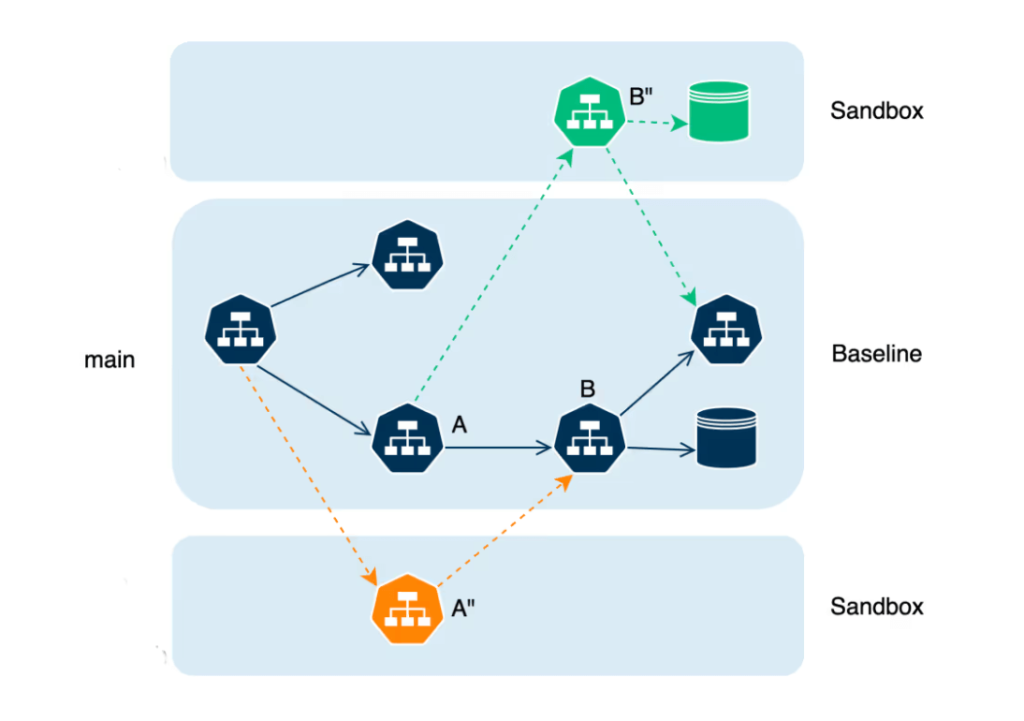

Now, that engineer can review three different AI-generated PRs in an hour. They can run a full suite of end-to-end (E2E) tests against each one. They’re not validating code in a vacuum; they’re validating outcomes in a real-world environment.
This brings me to my last point: testing.
What about running all those tests? K8s gives you the ultimate building blocks. Sure, you could just use a managed CI provider, but that’s like building your factory inside someone else’s warehouse. You’re stuck with their rules, their limitations and their pricing. You’ll inevitably outgrow it. K8s is about owning the factory itself. It gives you the control to build a custom validation platform that is tailored precisely to your company’s workflow. You’re not renting a generic tool; you’re building a durable, competitive asset.
Your whole validation pipeline runs on the same platform as your application.
Kubernetes Jobs are triggered, hammering that sandbox’s preview URL with E2E tests, load tests and contract tests.This is how you build an “experimentation engine,” not a “CI/CD pipeline.” You’re creating a factory for validating hypotheses at scale. The human’s job is to manage the factory, not turn the wrenches.
So yes, K8s is complex. It’s a beast. But in an era where code is generated instantly, the battleground has shifted from creation to validation. And the only platform built to handle that level of high-concurrency, isolated, on-demand experimentation at scale is Kubernetes.
If you’re in growth mode, speed of innovation is all that matters. Stop arguing about YAML and start building your experimentation engine.
Get the latest updates from Signadot