Coding agent capabilities have advanced rapidly to enable them to iterate on code until correct, but in cloud-native systems, agents can only validate against a small, static slice of the system. This is what Signadot was built to solve.
Modern coding agents have come a long way on the inner loop. They write code, run it, read the output, and use what they learn to make the next change. That cycle is the reason agentic coding works at all. The trouble is that an agent can only validate its work against the environment it has access to, and for teams building cloud-native systems, that environment is not enough to validate that the code will work in production.
For a simple application, the loop is tight. Edit a file, run the test suite, see green, move on.
For a microservices application running on Kubernetes, the same agent has no way to tell whether the change still works once it’s running alongside thirty other services, six databases, four message queues, and the third-party APIs the system depends on. The agent generates code that looks right in isolation. Whether it works in the real system is a question it cannot answer on its own.
This is the problem Signadot was built to solve. The video above gives the short version. Read on for how we enable more autonomous coding agents that deliver working code for cloud-native teams.
Coding agents work because the inner loop they run gives them a real signal. Generate, run and validate, observe, adjust. The quality of every iteration depends on what “run and validate” actually exercises. When that’s a unit test in a single codebase, the signal is tight and the loop converges. When it’s a change to a cloud-native system, the loop only converges if the agent can run the change against the real system, and that is the part that breaks down.
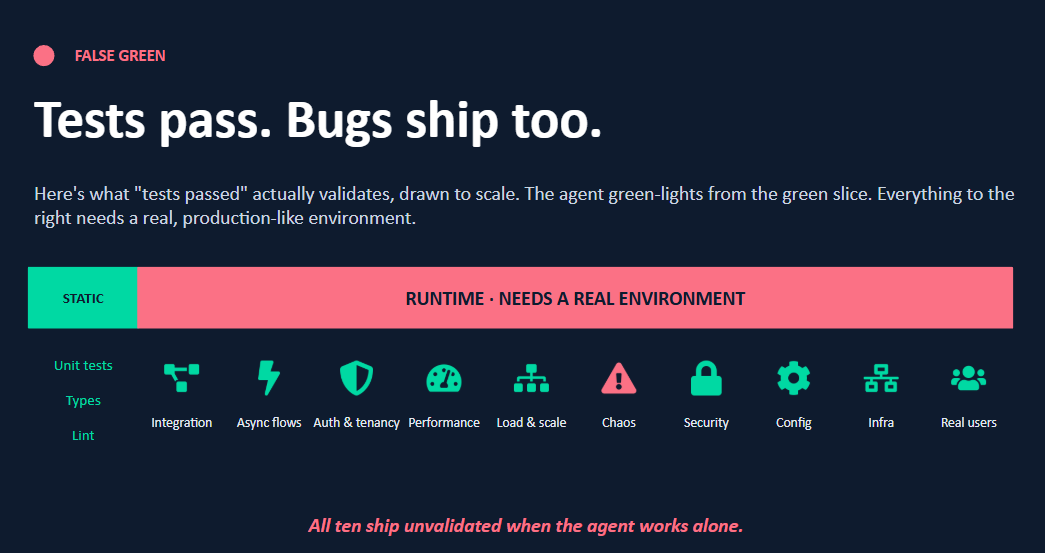
Cloud-native is a runtime problem. You cannot reason your way to correctness when the system has more state than the agent’s context window. A single change ripples. Most features touch services someone else owns, and each touch is a place to break.
Mocks encode whatever assumptions the developer baked in, which is exactly what real bugs tend to violate. Unit tests verify the unit, not how a change behaves when it has to call the order service, which calls another service, which reads from Redis, while a Kafka consumer is also handling a partial refund.
So when an agent declares a change green, it’s green against a small static slice. Everything that decides whether the change works in production sits outside that slice.
The standard fallback is shared staging. One environment, contended across every team and every change. It was already under strain at large engineering orgs. At agentic scale, it breaks down completely.
Without a real environment to run against, the agent ends up generating best guesses and handing them off to a developer to verify. The leverage that was supposed to come from agentic coding gets absorbed into review.
For an agent to close its loop with realistic validation against a cloud-native system, it needs an environment with three key features:
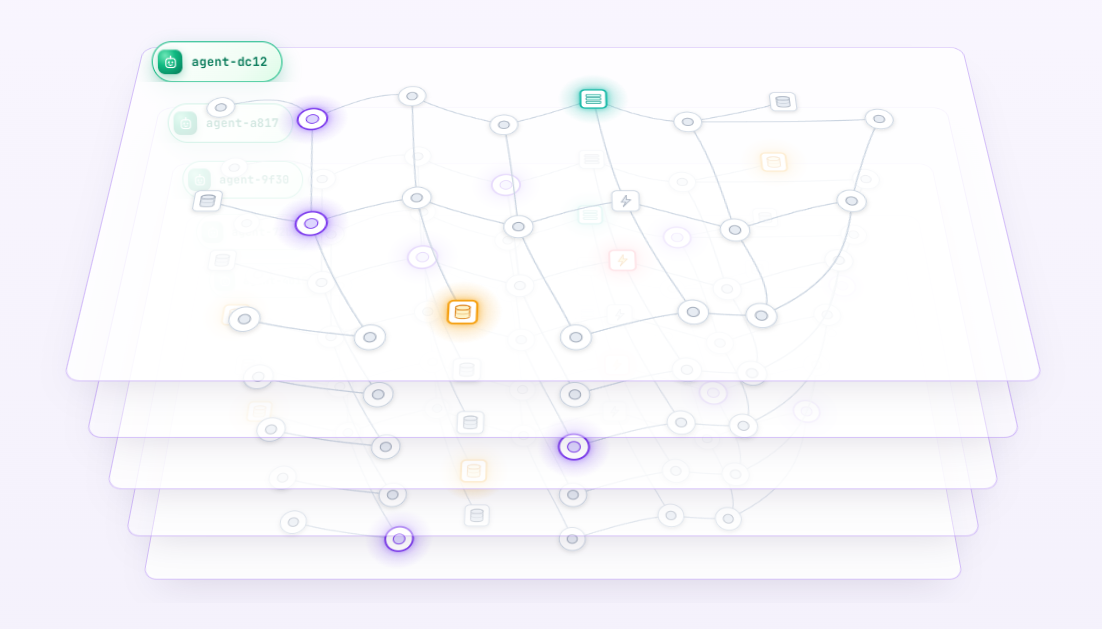
Signadot gives agents lightweight ephemeral environments that spin up in seconds and virtualize the full stack. Each one looks and behaves like a production-like system to the code running inside it, with real services, real data stores, and real message brokers. The agent gets the fidelity it needs to validate its work, in the time it takes to run a test.
Signadot stays cheap and fast by sharing your existing Kubernetes cluster instead of duplicating it. Your services, databases, queues, and caches run once. Every agent run gets an environment containing only the components the change actually modifies. Everything else is virtualized, with a different mechanism at each layer.
Services are routed: requests carry routing context, and the cluster steers them to the modified service when one exists for that environment, falling back to the existing service otherwise.
Queues are tagged: messages carry an environment identifier, and consumers only pick up messages with the matching tag, so parallel agents can produce to the same Kafka topic without seeing each other’s traffic.
Databases are branched: each environment gets a copy-on-write branch on supported databases, so writes are isolated without paying the cost of a full clone.
The result: a single Kubernetes cluster can host thousands of full-stack environments at once, one per agent run, each behaving as if it owns the whole system. The infrastructure cost looks like one stack, not a thousand.
Signadot exposes this capability through a set of building blocks and tools.
The MCP Server connects your coding agent to Signadot directly. The agent can spin up an ephemeral environment for a change, run tests inside it, fetch cluster context, and iterate, all from a single prompt. Cursor, Claude Code, Codex, Windsurf, and other MCP-compatible agents work with it out of the box.
An agent running on a laptop or a background agent spins up a Signadot Sandbox and gets end-to-end access to real cluster dependencies as if the local code were running in the cluster. This is the piece that closes the gap between the agent’s workspace and the real system.
With these pieces in place, the agent’s inner loop on a cloud-native system starts to look like the inner loop on a simple application. Write the change. Spin up an environment. Validate broadly across the runtime axes that matter. Debug against real signal. Loop until the tests pass.
Hundreds of agents can run this cycle in parallel on the same cluster without contention.
What lands in front of a human reviewer is different too. Instead of a diff plus a hope, the reviewer gets a change that has already cleared real tests against a production-like system. The reviewer’s job moves up the stack, from catching obvious breakage to making judgment calls about design, risk, and intent.
Agents that iterate against the real system, not just suggest against a mock of it. Changes that are shippable when they reach review. Signadot is the runtime validation layer that makes it possible.
Get the latest updates from Signadot