
Image by Susan Q Yin from Unsplash.
The adoption of microservices architectures has introduced significant complexity into the software development lifecycle. While this architectural style offers scalability and modularity, it creates challenges for development and testing, particularly in replicating production-like environments efficiently. Tools that bridge local development with remote Kubernetes clusters have become essential for developer productivity.
Telepresence is a well-known tool in this domain, enabling developers to proxy traffic between their local machine and a remote cluster. However, the landscape of microservices development tools is evolving. This article provides a technical comparison of leading alternatives to Telepresence, examining different approaches to environment management, from direct local-to-cluster proxies to comprehensive testing platforms like Signadot.
In monolithic applications, developers could run and test the entire system on their local machines. With microservices, this is often impossible due to the sheer number of services and their dependencies. This leads to a “feedback loop crisis” where developers must wait for long CI/CD cycles to deploy changes to a shared staging environment before they can validate them [1].
Traditional staging environments present several problems:
To address these issues, a new class of tools has emerged to create isolated, on-demand testing environments. These tools can be broadly categorized into local development proxies and ephemeral environment platforms.
Telepresence and its direct alternatives focus on connecting a developer’s local workstation to a remote Kubernetes cluster. They work by intercepting and redirecting network traffic, allowing a single service running locally to communicate with its dependencies in the shared cluster.
Under the hood, Telepresence launches a local agent and deploys a lightweight proxy container (often called the “traffic manager”) into your Kubernetes cluster. It intercepts outbound service calls and DNS lookups, routing them over a secure network tunnel back to your local process. Responses are sent back through the tunnel, making your local code appear as if it were running directly inside the cluster.
While local proxies are effective for individual developer workflows, they do not fully address the challenges of collaborative testing, pull request validation, and automated end-to-end tests. Ephemeral environment platforms offer a more comprehensive solution by creating isolated testing environments within the Kubernetes cluster itself.
Signadot provides a microservices testing platform that moves beyond local proxying to enable scalable, on-demand testing environments called Sandboxes. Instead of connecting a local machine, Signadot spins up a version of the service under test within the cluster for each pull request.
This approach is built on two core principles:
This model supports a broader range of use cases, including:
By optimizing the development lifecycle within Kubernetes, platforms like Signadot have demonstrated significant improvements, including a reported 10x increase in developer speed and an 80% reduction in testing time for engineering teams.
Signadot’s traffic routing model works natively with service meshes like Istio and Linkerd. We also offer our own sidecars based on Envoy if you don’t have a mesh. This enables an extended set of use cases natively within Kubernetes and extends far beyond local development.
Besides Telepresence and Signadot, the following tools offer local development proxies and environment replication for Kubernetes:
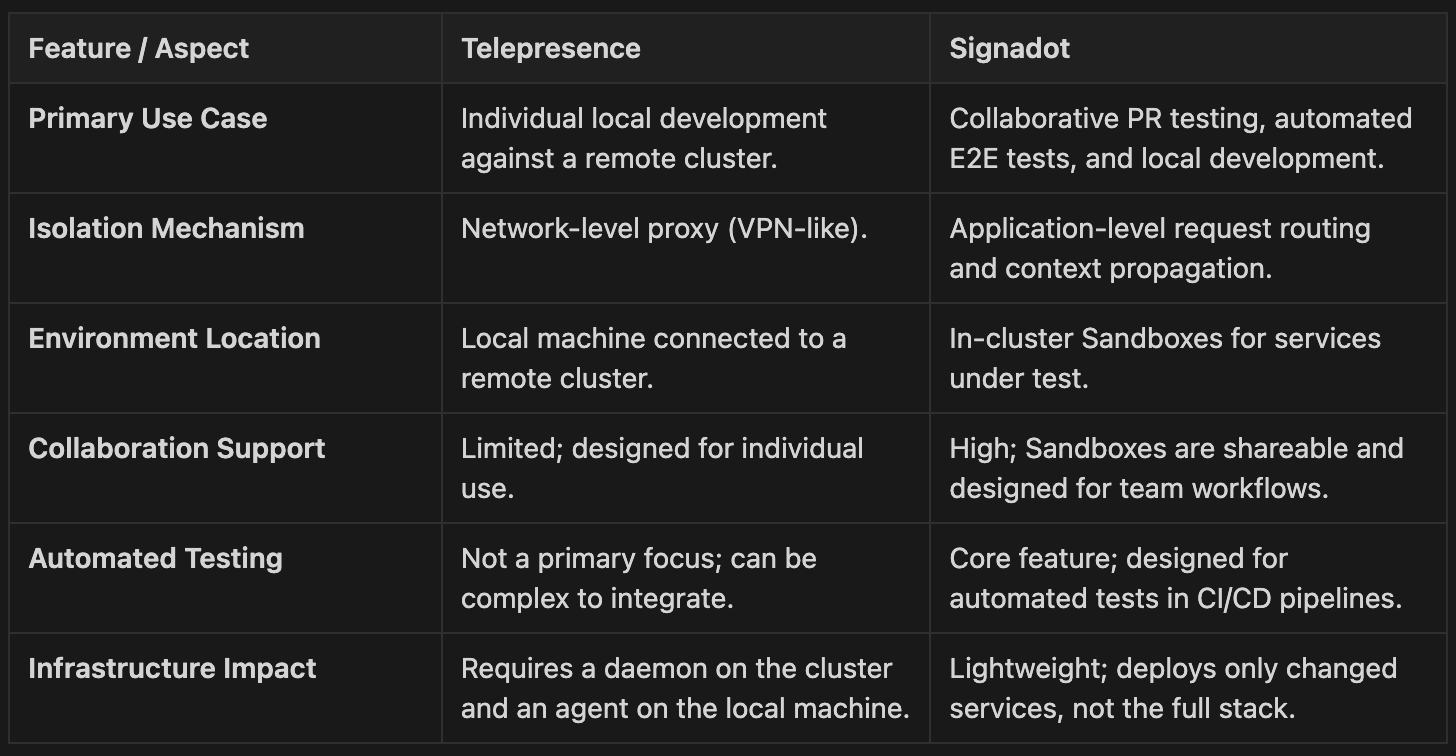
Choosing the right tool depends on the specific needs and scale of the engineering organization. The landscape has evolved from tools that simply connect a local machine to a remote cluster to comprehensive platforms that manage the entire testing lifecycle within Kubernetes.
Ultimately, the most effective strategy often involves a combination of these tools: a platform like Signadot to manage environments and run automated tests, integrated with API and UI testing frameworks like Postman and Cypress, all orchestrated through a robust CI/CD pipeline.
Get the latest updates from Signadot