
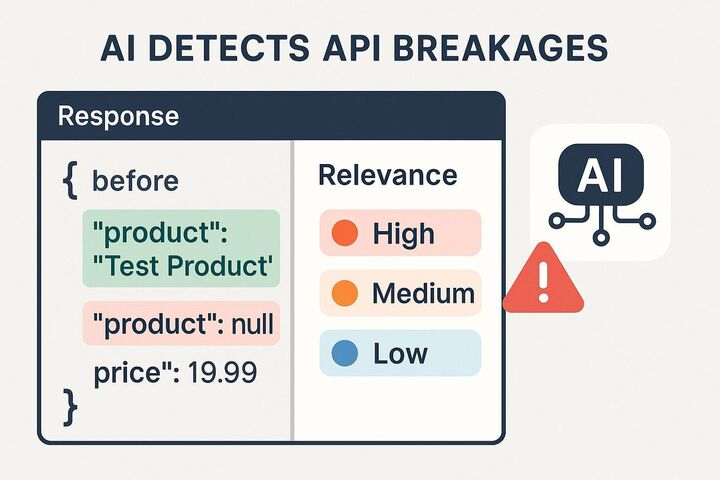
Microservices architectures promise agility and scalability, but they also introduce a new set of integration challenges. Integration failures are among the top causes of downtime and deployment delays in distributed systems. When API changes are introduced, even a minor contract mismatch can cascade into production outages, broken features, and frustrated teams. Signadot SmartTests offers a proven approach to prevent these issues before they reach users, enabling faster releases and more reliable systems.
Microservices rely on well-defined APIs to communicate. When one service changes its API without informing consumers, integration failures occur. Traditional end-to-end (E2E) testing attempts to catch these issues but often falls short due to high infrastructure costs, slow feedback loops, and the complexity of replicating entire environments [1]
Contract testing addresses these pain points by validating the agreements (contracts) between services at the API level. This approach ensures that both providers and consumers adhere to the same expectations, reducing the risk of runtime errors and deployment failures [2]
Key Benefits of Contract Testing
Example: A payment service updates its API response format. Without contract testing, dependent services may break silently. With contract testing, mismatches are caught during development, preventing outages.
Implementing contract testing effectively requires a disciplined approach. The following best practices help teams avoid integration issues and maintain robust microservices architectures:
Start by documenting precise request and response formats, including data types, required fields, and error codes. Clear contracts prevent ambiguity and set expectations for both providers and consumers[3].
Integrate contract tests into your continuous integration and deployment workflows. Automated testing catches contract violations early, reducing the risk of late-stage failures.
APIs evolve over time. Version contracts to maintain backward compatibility and avoid breaking existing consumers when introducing changes.
Use mock servers to simulate provider or consumer behavior. This allows teams to test interactions in isolation, speeding up development and reducing dependencies on other teams[3].
Checklist: Contract Testing Best Practices
Selecting the right contract testing tool depends on your technology stack, team workflows, and integration needs. Leading tools support a range of languages and frameworks, and many integrate with popular CI/CD systems[3].
Comparison Table: Key Criteria for Contract Testing Tools
Criteria
Description
Impact on Teams
Language Support
Range of supported languages and frameworks
Enables adoption across stacks
Mocking Capabilities
Ability to simulate providers/consumers
Supports isolated testing
CI/CD Integration
Ease of automation in pipelines
Accelerates feedback
Contract Versioning
Support for API evolution
Maintains compatibility
Reporting & Analytics
Quality of test result insights
Informs decision-making
Running contract tests in Kubernetes presents unique challenges. Traditional approaches often require replicating entire environments, leading to high infrastructure costs and slow test cycles. Modern platforms now offer lightweight, ephemeral environments that deploy only the changed components, connecting them to existing services for realistic testing.
Example: A developer submits a pull request for a new API feature. An ephemeral environment spins up the changed service, connects it to live dependencies, and runs contract tests automatically. Feedback is delivered within seconds, allowing rapid iteration.
SmartTests by Signadot takes contract testing to a new level. Instead of relying on manually written contracts or brittle mocks, SmartTests automatically detects real API interactions between microservices during normal development workflows. It captures these interactions from production-like traffic or CI environments, generating a baseline contract for existing services.
As new code is introduced, SmartTests compares it against this baseline using ephemeral environments in Kubernetes—without requiring test authoring or environment duplication. It flags breaking changes instantly, allowing teams to fix issues before merge time.
Example: A developer changes a service’s response field from amount to total_amount. SmartTests detects this schema mismatch against real consumers and flags it before merge—no mocks or staging environments needed.
Contract testing is essential for reliable microservices—but manual approaches are too brittle and time-consuming to scale. SmartTests automates this process, analyzing real API usage to identify breaking changes as early as possible.
By combining AI analysis, observed traffic, and ephemeral Kubernetes environments, SmartTests enables:
Modern engineering teams are adopting SmartTests to eliminate integration surprises, streamline development, and scale confidently. If you’re running microservices in Kubernetes, SmartTests is the contract testing solution designed for how you actually build today.
[2] https://www.frugaltesting.com/blog/what-is-contract-testing-a-complete-guide-for-beginners
Get the latest updates from Signadot